 12 October 2026 · Articles


Modernising Prison Education Through Digital Self-Employment Education
Prison education is key to rehabilitation, equipping individuals with skills and confidence for life after release. Amid recent challenges in the Prison Education Service, NEC Digital Studio and RIFT Social Enterprise have partnered to expand access to self-employment education through an innovative digital solution.

Challenges in prison education
The prison education sector is currently facing considerable constraints. The rollout of the new Prison Education Service has resulted in an average 25% reduction in planned education delivery due to increased operational costs. This reduction has led to fewer available learning hours, longer waiting lists, and in some cases the removal of courses altogether. As prisons prioritise foundational skills such as literacy, numeracy, and digital competence, specialised programmes often face the greatest risk of being reduced or discontinued.
These limitations have direct consequences for rehabilitation outcomes. Reduced learning opportunities can negatively affect employability, work readiness and personal development. For learners interested in self-employment, the impact can be particularly significant. Entrepreneurship offers an important alternative to traditional employment, especially for individuals who may face barriers due to their criminal records. Without access to relevant training and support, many prisoners lose the opportunity to develop the confidence and practical skills required to pursue business ventures upon release.
At the same time, there is an increasing need for continuity of learning and support after release. Many learners begin developing business ideas while in custody but struggle to maintain momentum without structured “Through the Gate” support. Addressing these challenges requires innovative approaches that can deliver education more efficiently while maintaining quality and accessibility.
Digital approach to deliver self-employment workbooks
Recognising these challenges, including the need for continuity of learning and support after release, RIFT Social Enterprise and NEC Digital Studio developed a digital self-employment programme that leverages existing prison technology infrastructure. Many learners begin developing business ideas while in custody but can struggle to maintain momentum without structured “Through the Gate” support. To help address this, RIFT contributed its award-winning self-employment workbooks, which were co-created with individuals who have lived experience of the criminal justice system and endorsed by the Institute of Enterprise and Entrepreneurs (IOEE). These materials are specifically designed to make complex business concepts easy to understand and apply.
NEC brought its expertise in digital learning and its widely used Virtual Campus platform, already available across prisons in England and Wales. Using rapid content-generation technology, the team transformed RIFT’s workbook content into an interactive digital learning experience. The resulting programme lets learners complete exercises digitally, build business portfolios, and work independently either in-cell or through prison learning facilities. The solution offers several important benefits including:
- Immediate implementation
- Delivered at approximately 10% of the cost of traditional face-to-face provision
- Scaled to unlimited users
- Prisons receive technical support, reporting, and a flexible model that complements existing education programmes
- Learners receive certificates upon completion
Early pilot deployments have demonstrated positive learner feedback, with participants reporting increased confidence, greater motivation and improved readiness to pursue self-employment opportunities.
“I completed all the activities and found it very easy to understand. It was very interesting, the activities were very useful in helping me plan, and I found it easy to keep going. Before starting I wasn’t sure I was confident in starting a business; kind of ok with the idea, but now I feel quite confident. The course gave me confidence, and I feel well prepared to make a go of it.” – Learner
Conclusion
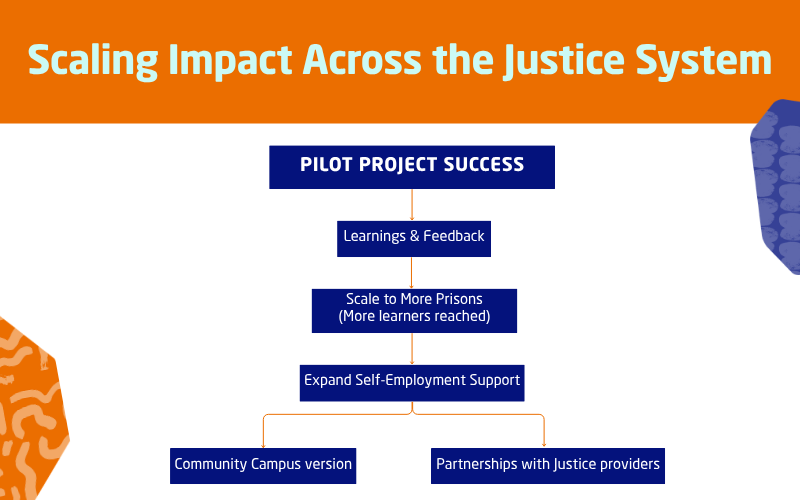
The collaboration between RIFT Social Enterprise and NEC demonstrates how digital innovation can help overcome some of the most pressing challenges facing prison education today. By combining accessible enterprise learning content with established digital infrastructure, the partnership provides a scalable and cost-effective way to expand educational opportunities for people in custody.
More importantly, the initiative supports rehabilitation through practical skills development, increased self-confidence, and new employment pathways. As the programme expands to additional prisons and potentially into community-based platforms supporting learners after release, it will create a seamless educational journey from custody to community. In doing so, it offers a compelling model for how technology, social enterprise and justice-sector collaboration can work together to improve outcomes, engage with more offenders, and reduce reoffending.
If you’d like to discuss the challenges facing prison education, explore approaches to digital learning delivery, we’d be happy to arrange a conversation:
Related insights
12 October 2026 · Articles
 24 September 2026 · Articles